
What Ogden’s hard water does to a water heater
If you want one explanation for why water heaters here fail earlier than the brochure suggests, it is the water. Three things it does.
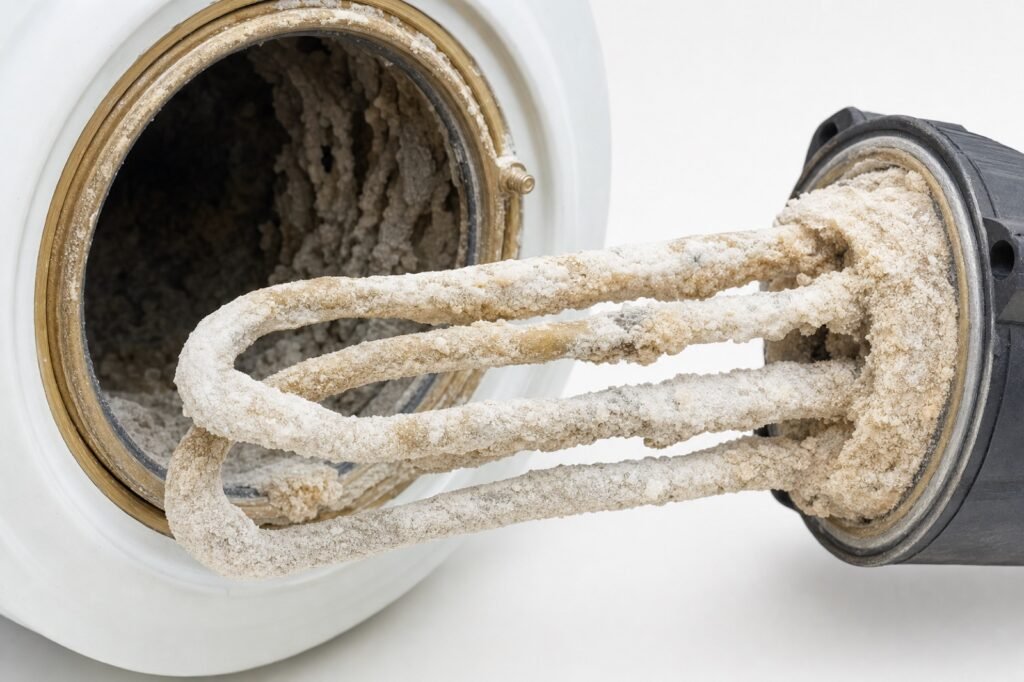
More than anything else does. If you want one explanation for why water heaters in Weber, Davis and Morgan County fail earlier than the brochure suggests, it is the water.
What hard water actually is
Dissolved calcium and magnesium, picked up as water moves through rock. Northern Utah water, largely sourced off the Wasatch and through the Weber Basin system, carries a lot of it. It is perfectly safe to drink. It is hard on appliances.
When hard water is heated, those minerals come out of solution and settle. In a water heater they settle on the floor of the tank, directly above the burner.
The three things that then happen
1. The rumbling
Water gets trapped under the scale layer, boils, and forces its way up through it. That is the popping and rumbling people describe. It is not the tank about to fail; it is sediment. A flush usually settles it.
2. The gas bill goes up
Scale is an insulator. The burner is now heating a layer of mineral instead of heating water, so it runs longer for the same result. Nobody notices this because it happens gradually over years.
3. The tank corrodes faster
This is the expensive one. Sediment traps heat against the steel at the tank floor, which accelerates corrosion exactly where the tank is most vulnerable. Meanwhile the anode rod, the sacrificial component that is supposed to corrode instead of the tank, is being consumed faster in mineral rich water.
Once the rod is gone, the tank starts corroding. That is the one failure nobody can repair.
What this means for service life
Manufacturers quote figures based on average conditions. In this water, eight to twelve years is realistic, and where a specific heater lands in that range is decided almost entirely by whether anyone ever flushed it and changed the rod.
A neglected tank failing at seven is common here. A serviced one reaching twelve is equally achievable. That is roughly five years of service, and the difference is a few hundred dollars of maintenance.
What to actually do about it
- Flush annually. Not every two or three years. The water here justifies annual.
- Have the anode rod checked past year five. It is usually spent by then and almost nobody replaces it.
- Consider softening if you are already spending on it. It helps the heater, the dishwasher, the kettle and the fixtures.
- Think hard before tankless without softening. Scale kills tankless heat exchangers faster than it kills tanks, and it voids most warranties. This is the single biggest reason we are cautious about recommending tankless here.
The honest summary
Hard water is not a reason to replace a heater. It is a reason to service one. A flush and a rod at $150 to $325 is the cheapest thing on our price list and the one that keeps a tank off the rest of it.
If yours has never been serviced and you do not know its age, we will read it off the serial and tell you what it has left. That is what water heater repair in Ogden should be doing before anyone talks about replacing anything.
Not sure which applies to yours? Tell us what it is doing.
Get an honest diagnosisTell us what it is doing
Three questions. We will tell you whether this is a part or a tank, and roughly what each one costs, before anybody schedules anything.
Mon to Sat, 7am to 7pm. Emergency service available.
Most repair calls are seen the same day. Replacements are usually next day, sooner if the tank is leaking.
What most likely failed, whether it is a part or the tank, and what each option costs. In writing, before anything is scheduled.
Based in Ogden, UT. We come to you across nineteen cities in Weber, Davis and Morgan County.
No obligation, and no in home visit needed to get a straight answer. If it sounds like a repair on the phone, we will say so.