
Are gas water heaters being phased out?
Not banned, but the rules have tightened and the direction of travel is real. What that actually means for your next replacement.
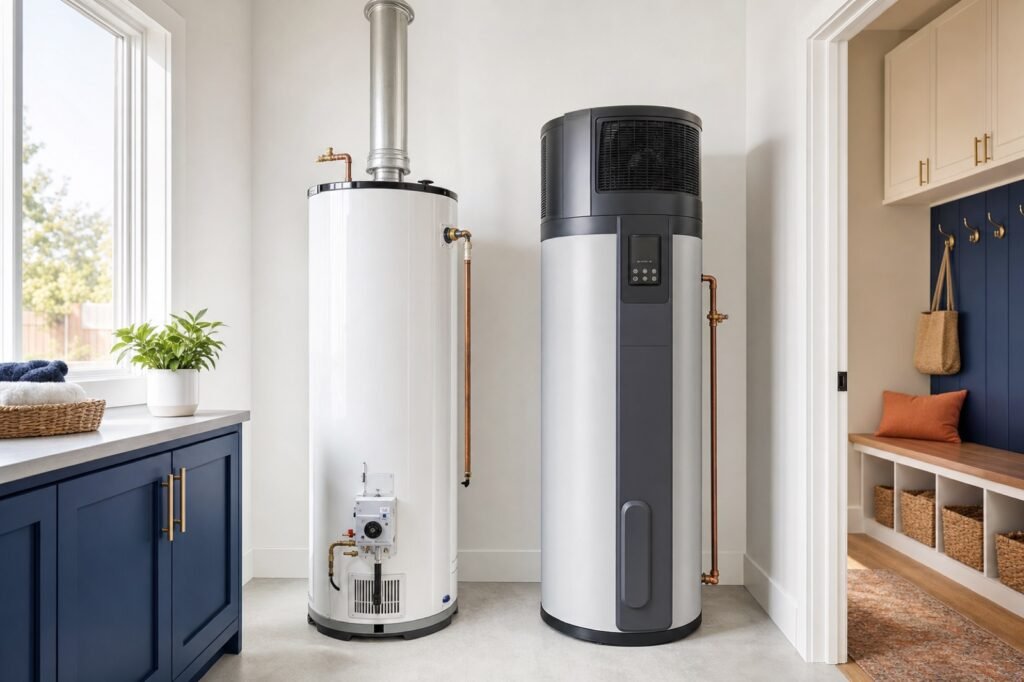
Not banned, but the rules around them have tightened, and the direction of travel is real. If you are replacing a heater in the next few years this affects what is on the shelf and what it costs.
Here is what is actually happening, without the alarm.
What has changed
Federal efficiency standards for water heaters have been raised in stages. The practical effect on gas tank units is that hitting the higher efficiency numbers on larger tanks generally requires condensing technology, which is more complex and more expensive than the atmospheric vented heater most Utah homes currently have.
Smaller and mid sized gas tanks are still widely available. The squeeze is at the larger end and on the cheapest builder grade units.
What is not happening
- Nobody is coming to remove your gas water heater. Existing units are unaffected.
- You will not be forced to convert to electric when yours fails.
- Gas replacements are still available and still what we fit in most Northern Utah homes.
What it means for your next replacement
Three things, in order of how much they matter:
1. Prices drift upward
Higher efficiency requirements mean more materials and more complex units. Our current gas replacement pricing is $2,100 to $3,250 fitted, and that is not going down over time.
2. Venting gets more involved
Condensing units vent differently from atmospheric ones and produce acidic condensate that has to drain somewhere. On a straight swap in an older home, that is the part that adds cost and complexity, not the heater.
3. Heat pump units become genuinely competitive
A heat pump water heater is several times more efficient than a standard electric one. In an open basement with enough air volume they work very well. In a small closet they underperform and they are not silent. Placement decides it, which is why we look at the space before recommending one.
Should you replace early to get ahead of it?
No. Replacing a working water heater to pre-empt a regulation is spending thousands to avoid a price rise of hundreds, and you lose whatever service life the current unit had left.
The better response is unglamorous: keep the one you have running longer. An annual flush and an anode rod at $150 to $325 buys years, and years is exactly what you want while the market settles.
What we would tell you if you asked today
If your heater is sound, service it and keep it. If it has genuinely failed, fit a good gas unit now while they are straightforward, or look seriously at a heat pump if the space suits one. If someone tells you gas is being outlawed and you must act immediately, they are selling you something.
If you want a straight read on what yours has left in it, that is what water heater repair in Ogden is for. Four of the five things that commonly go wrong are parts, not tanks.
Not sure which applies to yours? Tell us what it is doing.
Get an honest diagnosisTell us what it is doing
Three questions. We will tell you whether this is a part or a tank, and roughly what each one costs, before anybody schedules anything.
Mon to Sat, 7am to 7pm. Emergency service available.
Most repair calls are seen the same day. Replacements are usually next day, sooner if the tank is leaking.
What most likely failed, whether it is a part or the tank, and what each option costs. In writing, before anything is scheduled.
Based in Ogden, UT. We come to you across nineteen cities in Weber, Davis and Morgan County.
No obligation, and no in home visit needed to get a straight answer. If it sounds like a repair on the phone, we will say so.