
How often do water heaters actually burst?
Rarely, and almost never without warning. What is common is a slow leak that runs for days and does the same damage more quietly.
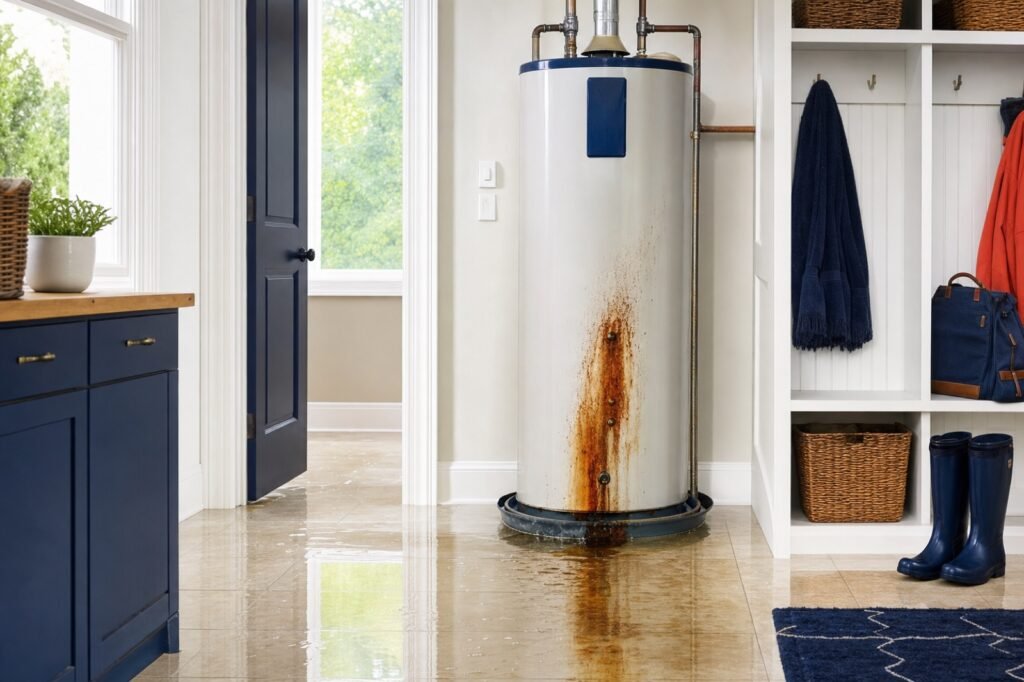
Rarely, and almost never without warning. The genuinely catastrophic failures people picture, a tank splitting open and flooding a basement in minutes, are a small fraction of what actually happens.
What is common is a slow leak that runs for days behind a furnace or under a stair, and does the same damage more quietly.
What “burst” usually means in practice
A steel tank does not explode. It corrodes from the inside until the liner is breached, and then it weeps. Sometimes that weep becomes a steady run. Occasionally a seam lets go and you get the dramatic version. But the failure has usually been developing for a year or more before you see a drop of water.
That is the useful part: it is nearly always preceded by signs that are easy to read if anyone is looking.
The warnings that come first
- Rusty or discoloured hot water that does not clear after a flush. The anode rod is gone and the tank lining is going.
- Rumbling, which is sediment, and sediment accelerates corrosion at the tank floor.
- Damp or staining at the base that comes and goes. That is a weep, not a spill.
- The relief valve discharging repeatedly, which points at pressure the tank is absorbing every heating cycle.
- Age past twelve years with no service history. Not a diagnosis on its own, but combined with any of the above it is meaningful.
The one failure that is genuinely sudden
A stuck thermostat combined with a failed temperature and pressure relief valve. The tank keeps heating, pressure has nowhere to go, and the result is violent. This is why that valve exists and why it is worth testing annually. It is also why we will not sign off on an installation where the relief discharge has been capped or plumbed somewhere it cannot discharge safely.
That is a rare combination, because it needs two separate things to fail. It is also entirely preventable, which is most of the argument for annual maintenance at $150 to $325.
What reduces the damage rather than the odds
- A drain pan that actually drains somewhere. Plenty of pans we find are sitting under a heater with no outlet, which just holds the water for longer.
- A leak sensor if the unit sits above finished space. They are inexpensive.
- Knowing where the shut off is before you need it. The cold inlet valve on top of the tank.
- An expansion tank at $200 to $300, so pressure is not working against the tank every cycle.
So should you replace a tank pre-emptively?
Not on age alone. A twelve year old tank that is sound, has a fresh anode rod and gets flushed is a reasonable thing to keep. A nine year old tank producing rusty water that does not clear is a different conversation, and that one we would replace.
The distinction is whether the steel is still intact, and that takes about twenty minutes to establish. If you want a straight read on yours rather than a guess based on its birthday, that is what water heater repair in Ogden is for. If it turns out to be a part, we will tell you that instead, and repairs start at $225 against $2,100 to replace a gas unit.
Not sure which applies to yours? Tell us what it is doing.
Get an honest diagnosisTell us what it is doing
Three questions. We will tell you whether this is a part or a tank, and roughly what each one costs, before anybody schedules anything.
Mon to Sat, 7am to 7pm. Emergency service available.
Most repair calls are seen the same day. Replacements are usually next day, sooner if the tank is leaking.
What most likely failed, whether it is a part or the tank, and what each option costs. In writing, before anything is scheduled.
Based in Ogden, UT. We come to you across nineteen cities in Weber, Davis and Morgan County.
No obligation, and no in home visit needed to get a straight answer. If it sounds like a repair on the phone, we will say so.